En🇺🇸Pt🇧🇷↓
When we talk about Brazilian Zouk, we talk a lot about connection, body movement, musicality, leading and following, lines, head movement, dynamics. But how often do we actually talk about our legs?
And I don't mean the feet as something that simply takes us from one place to another. I mean the entire work of the legs: how we transfer weight, how we use the floor, how we move through space, how we control our balance, and how all of that affects the rest of our body and our partner.
Maybe we don't give enough attention to it.
Think about something like the Monastery from Hip Hop. What makes that movement interesting isn't simply the position of the feet. There is a whole relationship between the legs, the weight, the floor, the timing and the organization of the body. The feet are only part of what we see. The movement is actually happening through the entire lower body.
So why don't we explore this more in Brazilian Zouk?
We already understand that our upper body can interpret music. We can use the chest, the hips, the arms, the head, the spine. We can change texture, dynamics, speed and intention. But our legs can do exactly the same.
A step can be soft or sharp. It can travel, stop, accelerate or suspend. We can change where the weight lands, how quickly it transfers, how much we use the floor, or how we coordinate the legs with the rest of the body.
And suddenly, something that looked like “just footwork” becomes another way of interpreting the music.
Every time we dance, our legs are making decisions. Where is my weight? Where am I going? How stable am I? How quickly can I change direction? How much freedom do I have to move? What is my partner feeling through my body?
These questions become especially important in partner dancing because our movement doesn't exist in isolation. The way I step affects my balance. My balance affects my connection. My connection affects what my partner can do.
So developing our work with the legs isn't necessarily something that takes us away from connection. It can actually give us more possibilities within it.
Hip Hop, House, Jazz, and many other dance styles have developed incredibly rich ways of working with the legs. Why shouldn't we study them? Why shouldn't we allow those ideas to challenge the way we move in Zouk?
For me, the important question isn't whether a movement comes from Zouk or from somewhere else. The question is: how does it become part of the dance?
If we take a movement from another style and simply place it on top of Zouk, it can feel disconnected. But if we understand the mechanics behind it, understand the relationship with the floor, the timing, the weight transfer and the body organization, we can translate that idea into our own dance without losing what makes Zouk work; and that process can open a lot of doors.
Maybe we have been thinking about footwork too narrowly.
Maybe it isn't just something we add when we want to “do something different.” Maybe it can change the way we understand musicality, balance, connection and movement itself.
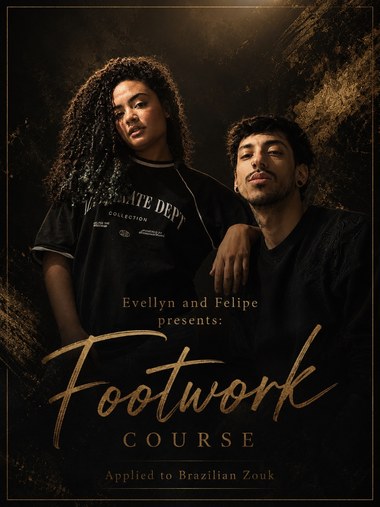
Want to go deeper into this? Evellyn Lethicia and I put it into a course: Footworks Applied to Brazilian Zouk. Over 16 footwork variations, broken down step by step, with separate guidance for leaders and followers. It is out now.
Pt🇧🇷
Quando a gente fala de Zouk Brasileiro, fala muito de conexão, movimento de corpo, musicalidade, condução e resposta, linhas, movimento de cabeça, dinâmica. Mas com que frequência a gente fala das nossas pernas?
E eu não estou falando dos pés como uma coisa que simplesmente leva a gente de um lugar para o outro. Estou falando do trabalho inteiro das pernas: como a gente transfere o peso, como a gente usa o chão, como a gente se desloca no espaço, como a gente controla o equilíbrio, e como tudo isso afeta o resto do corpo e o nosso par.
Talvez a gente não dê atenção suficiente para isso.
Pensa em uma coisa como o Monastery do Hip Hop. O que deixa aquele movimento interessante não é simplesmente a posição dos pés. Existe uma relação inteira entre as pernas, o peso, o chão, o tempo e a organização do corpo. Os pés são só uma parte do que a gente vê. O movimento está acontecendo, na verdade, por todo o trem inferior.
Então por que a gente não explora mais isso no Zouk Brasileiro?
A gente já entende que o nosso tronco pode interpretar a música. A gente pode usar o peito, o quadril, os braços, a cabeça, a coluna. A gente pode mudar textura, dinâmica, velocidade e intenção. Mas as nossas pernas podem fazer exatamente a mesma coisa.
Um passo pode ser suave ou seco. Ele pode viajar, parar, acelerar ou suspender. A gente pode mudar onde o peso cai, com que rapidez ele é transferido, o quanto a gente usa o chão, ou como a gente coordena as pernas com o resto do corpo.
E de repente, uma coisa que parecia “só footwork” vira mais uma forma de interpretar a música.
Toda vez que a gente dança, as nossas pernas estão tomando decisões. Onde está o meu peso? Para onde eu estou indo? O quanto eu estou estável? Com que rapidez eu consigo mudar de direção? Quanta liberdade eu tenho para me mover? O que o meu par está sentindo através do meu corpo?
Essas perguntas ficam especialmente importantes na dança a dois, porque o nosso movimento não existe isolado. O jeito como eu piso afeta o meu equilíbrio. O meu equilíbrio afeta a minha conexão. A minha conexão afeta o que o meu par consegue fazer.
Então desenvolver o nosso trabalho de pernas não é necessariamente uma coisa que afasta a gente da conexão. Na verdade, isso pode dar mais possibilidades dentro dela.
Hip Hop, House, Jazz e muitos outros estilos de dança desenvolveram formas incrivelmente ricas de trabalhar as pernas. Por que a gente não deveria estudar isso? Por que a gente não deveria deixar essas ideias desafiarem o jeito como a gente se move no Zouk?
Para mim, a pergunta importante não é se um movimento vem do Zouk ou de outro lugar. A pergunta é: como ele se torna parte da dança?
Se a gente pega um movimento de outro estilo e simplesmente coloca ele por cima do Zouk, pode parecer desconectado. Mas se a gente entende a mecânica por trás dele, entende a relação com o chão, o tempo, a transferência de peso e a organização do corpo, a gente consegue traduzir aquela ideia para a nossa própria dança sem perder o que faz o Zouk funcionar; e esse processo pode abrir muitas portas.
Talvez a gente venha pensando o footwork de um jeito estreito demais.
Talvez ele não seja só uma coisa que a gente acrescenta quando quer “fazer algo diferente”. Talvez ele possa mudar o jeito como a gente entende musicalidade, equilíbrio, conexão e o próprio movimento.
Quer se aprofundar nisso? Eu e a Evellyn Lethicia colocamos tudo em um curso: Footworks Applied to Brazilian Zouk. Mais de 16 variações de footwork, destrinchadas passo a passo, com orientação separada para quem conduz e para quem responde. Já está no ar.
Comments
Loading comments…
You'll be asked to sign in before posting — we'll keep your draft.